×
Strengthening Health Ecosystem through Ayushman Bharat Health & Wellness Centres By NGO In Himachal Pradesh
A. Project Context
Joshimath, a small but significant town in the Chamoli district of Uttarakhand, holds immense religious, strategic, and geographical importance. Located in the Himalayas at an altitude of approximately 6,150 feet, it serves as the gateway to several pilgrimage and tourist destinations, including Badrinath, Hemkund Sahib, and the Valley of Flowers. However, the region’s fragile ecosystem, combined with rapid infrastructure development and climate change, has led to severe land subsidence issues, culminating in a major disaster. In early 2023, cracks began appearing in
houses, roads, and public buildings, raising alarm among residents and authorities. A detailed assessment revealed that 863 households had developed cracks due to land subsidence, rendering them unsafe for habitation. As a result, 278 families were displaced and relocated to safer locations identified by the District Disaster Management Authority (DDMA). The crisis had a profound impact on the local education system, with schools sustaining damage and many becoming unsafe for use. The displacement of families disrupted children’s education, forcing many to shift to temporary learning centers or nearby schools, often with inadequate resources. Anganwadi centers, crucial for early childhood development and nutrition, were also affected, with many workers struggling to provide services in unstable or temporary setups. Children, in particular, faced emotional distress from witnessing their homes being damaged and their communities being uprooted. The disaster underscored the urgent need for sustainable development, early warning systems, and stronger disaster resilience measures to protect vulnerable communities from such crises in the future.
B. Project Objective
Goal: To improve the Education, Health & Nutrition, and Resilience capacity of children and their families by ensuring learning continuity through TLC, strengthening health & nutritional services, and building coping capacity for future disasters
Objectives:
• To ensure learning continuity of the disaster-affected children through Temporary learning centers (TLC) by ensuring continuous and quality learning and providing Mental health & psychosocial support.
• Strengthening and facilitating health and nutritional services to children and their families through a community empowerment approach.
• To build the resilient capacity of children and their families & communities on disaster preparedness, and response through family and community preparedness and ensuring access to Social Protection Schemes.
C. Key Activities Implemented
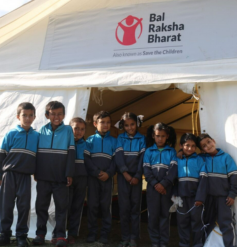
• Strengthening of the 08 TLC center to facilitate learning continuity of the children Identification of Out of School children and enrolling them in MAC
• Enhancing the capacity of health, Education and ICDS officers & Frontline Workers on FLN, Mental health and psychosocial, and hygiene promotion Implementing Bridge Course depending upon the results obtained in the pre-assessment and after complementation of bridge course enrolling them to formal education in their age-appropriate classes
• Facilitation of model Village Health, Sanitation and Nutrition Day (VHSND) at community level
• Provision of nutritional support to the identified malnourished children and mothers at high-risk pregnancy
• Disaster Management Planning through Participatory Vulnerability Capacity Analysis (PVCA)
• Family Emergency Plan (FEP)
• Formation and strengthening of Taskforce team at the community level.
• Consultation with line departments for sharing the community safety plans at the block & district level
D. Top-line of Results (outputs/outcomes) achieved.
• Throughout the project, a total of 516 children (Girls: 267 and Boys:249) received assistance, gaining access to continued education and safe, child-friendly learning spaces through the Education support
• This Project also witness the formation of the Task Force Team of the Total 216 members (Male-22 Female-46 Boys-72 Girls-76) and capacity building of these Task force through the 4 days training of on the Early Warning, First Aid, shelter Management & Rescue, thus, enhancing community preparedness and response capacity in disaster situations
• To strengthen Anganwadi Workers (AWWs) in Foundational Literacy and Numeracy (FLN) was undertaken, involving the training of 44 Anganwadi workers. These workers subsequently implemented these practices with children on the ground and strengthening early learning at the community level.
• The Capacity building of 32 school Teachers has been conducted during the period on the Mental Health and Psychosocial Support (MHPSS) to enhance their ability to recognize, respond to, and support children and community members facing mental health challenges.
• we also provide the Nutrition Kit to the 20 children (Boys-12, Girls-8) for 3 consecutive months to Supports brain development. Supports healthy growth. Boosts immunity. This sustained nutritional intervention aimed to address deficiencies and contribute to the overall well-being of the children, laying a stronger foundation for their health and development
• under the VHSND initiative we also provide the health monitoring equipment’s to the 13 Anganwadi Centers such as Fetoscope, BP Machine & Hemoglobin testing machine, which results in improved health outcomes for children and mothers, enhanced early detection of health issues, and better monitoring of vital signs, ultimately leading to a healthier community.
• This project also achieved the formation of PVCA report for the 9 wards in the Joshimath town and 2 villages of Pagnu and Thiang which support in identifying their vulnerabilities and capacities, fostering a sense of ownership and responsibility for their own development and disaster preparedness. The project was able to reach 640 Families through the PVCA activity. This process fostered a sense of ownership and responsibility towards their own development and disaster preparedness. Through this activity, 640 families were directly engaged, strengthening community resilience and participation in risk reduction planning